
Field note
Why an RPZ fails its annual test: debris on the check valves
A reduced-pressure assembly (RPZ) failed its annual test, and its two check modules were removed. Rust, scale and grit had settled on the seats, so neither check could seal. The body was sound. The fix was a clean-out and a rubber kit. The assembly was then retested and a new report filed. In our experience many failed tests look like this.
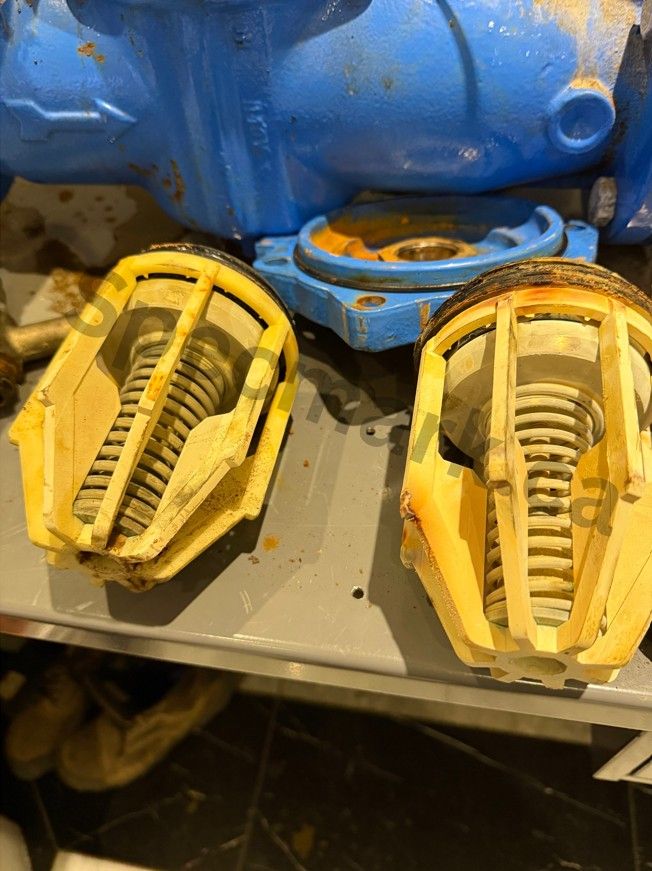
What we found
The assembly looked fine from the outside. On test, neither check would hold its differential, and the relief valve discharged as designed. With the checks out, the cause was visible: a layer of rust, scale and grit across both seats. Even a small piece of debris between a disc and its seat is enough to fail a check.
In a commercial building the debris usually comes from:
- rust and scale from older piping upstream
- sediment stirred up by water service work on the street
- dirt introduced during a plumbing repair
- small pipe fragments and deteriorated rubber from the system itself
The warning signs
In our experience property managers rarely see the debris. They often see the symptoms before the annual test:
- a relief valve on an RPZ that drips steadily
- a device that passes right after being flushed and then fails again
- repeated failures after municipal water work
Testers also see readings that change between visits.
The repair
The repair for fouled checks is the same on every job. The assembly is isolated and the check modules are removed. The seats and discs are cleaned and any worn rubber is replaced. The assembly is reassembled and retested, and the report is filed.
The device went back into service on the same visit, and the retest passed. The new report was filed with the municipality and the tag updated.
Repair or replace
Replacement was not the first answer here, and in our experience it usually is not. It becomes the practical choice when:
- the assembly is very old
- parts are hard to source
- the body is damaged
- the device is somewhere it cannot be worked on
A shut-off valve that will not hold is cleaned, repaired or replaced on its own, as the manufacturers advise.
In those cases we will say so and quote both options.
If failures repeat, the debris is coming from upstream. A new assembly would foul the same way, so the supply side is dealt with first.
Questions
Does a failed test mean the device has to be replaced?
Usually not. If the body and shut-off valves are sound, cleaning the checks and replacing the rubber parts restores most assemblies. In our experience replacement makes more sense when the device is very old, parts are unavailable or the body is damaged. A shut-off valve that will not hold is cleaned, repaired or replaced on its own, as the manufacturers advise. Replacement also makes sense or when the device is installed somewhere it cannot be serviced.
What should I send you if my device failed?
Send the failed test report and a photo of the device and its tag. Include the property address, any deadline or notice, and access details. That lets us bring the right kit and parts to the first visit.