
Field note
Why a pressure-wash station needs an RPZ
A pressure washer plumbed into a building's water supply is a cross-connection: the pump can push water, and whatever is in the hose, back toward the drinking water. Where the washer draws a detergent or degreaser that is dangerous to health, the programs class the hazard as severe. The connection then gets a reduced-pressure assembly (RPZ) with a relief valve to atmosphere, not a hose connection vacuum breaker.
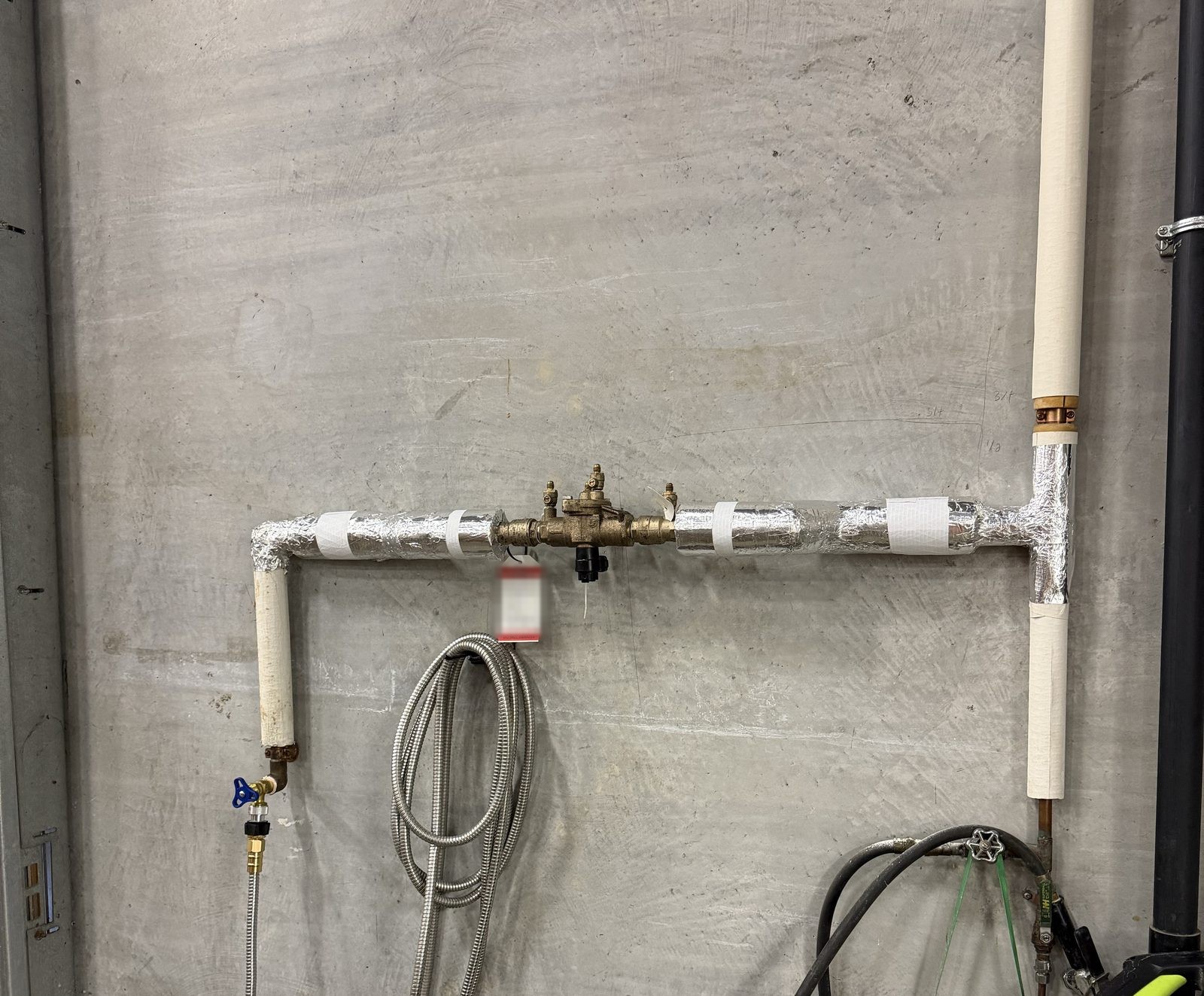
The cross-connection
The washer's pump takes building water and raises it to cleaning pressure. Two things can then go wrong. The pump can push water back up the supply line, which is backpressure. Whatever the washer is drawing at the time goes back with it: detergent, degreaser or dirty water from a hose end left in a bucket. The programs put substances dangerous to health in the severe class.
Why not a hose connection vacuum breaker?
The small brass vacuum breaker on a hose tap protects against backsiphonage only: if pressure in the main drops, it opens to air so nothing is sucked back. It does nothing against a pump pushing the other way. An RPZ has two check valves, with a relief valve between them that opens to atmosphere when the pressure between the checks comes too close to the supply pressure. If the first check leaks, or the second check leaks during backflow, the relief valve discharges the water to atmosphere. That discharge is also the visible sign that the assembly needs service. The device guide compares the types.
What the installation needs
An RPZ discharges from its relief valve when it detects a problem. The location needs:
- a drain that can take the discharge
- room to reach the test cocks with the test kit
- protection from freezing, which is why the supply here is insulated up to the assembly
This RPZ is tested at installation and every year after.
Questions
My pressure washer runs off a garden tap with a vacuum breaker. Is that enough?
A hose connection vacuum breaker only protects against backsiphonage, when supply pressure drops and water is drawn backward. A washer's pump creates backpressure, which a vacuum breaker does not stop. If the washer draws a detergent that is dangerous to health, the programs class the hazard as severe. That combination calls for an RPZ. Ask us, or your municipality's program, for the classification.
Does a small RPZ like this get tested every year?
In most programs, yes: the by-laws require a testable device to be tested at installation and every year, whatever its size. Durham's and Hamilton's programs are written around the premise-isolation device, so ask us what applies there.