
Backflow preventionCity of Hamilton, By-law 10-103
Backflow prevention requirements in Hamilton
This page sets out what the City of Hamilton requires for backflow prevention at industrial, commercial and institutional properties and multi-residential buildings of four storeys or more. The City runs its own program under its Prevention of Backflow By-law 10-103, and its Building Division issues the building permit for a new device. Send us the City's notice and we confirm the next step.
Who has to comply in Hamilton
Hamilton runs its own backflow program under the Prevention of Backflow By-law 10-103, passed on May 12, 2010 and amended in 2019. It applies to every industrial, commercial and institutional property and to multi-residential buildings of four storeys or more. Hamilton is a single-tier city: it is not part of Halton Region, and Halton's program does not apply here.
The Ontario Building Code's plumbing part (Part 7) and the CSA B64 standards also apply. The municipal by-law adds the program around them: who is surveyed, how often each device is tested, where the report goes and by when.
Two kinds of survey
The by-law sets the survey by the size of the water service.
- A Self-Assessed Survey, which the owner completes on the City's form, for a service of 38 mm (1½ inches) or smaller. There is no fee. Where more than one business shares the property, a survey is completed for each business.
- A Cross Connection Survey by a contractor registered with the City, for any larger service. The by-law's threshold is above 38 mm, while the City's program page says 50 mm or larger. For a service between the two, we confirm with the City which survey applies. The City can also require one after a Self-Assessed Survey. The signed original and the City's fee are delivered within 14 days of the survey.
Both are repeated every 5 years. A new survey is also due within 30 days of a change in the hazard level, the ownership, or the equipment the last survey covered.
Installation and testing
The City's survey acknowledgement states the hazard level, in the by-law's terms, and the hazard level sets the device:
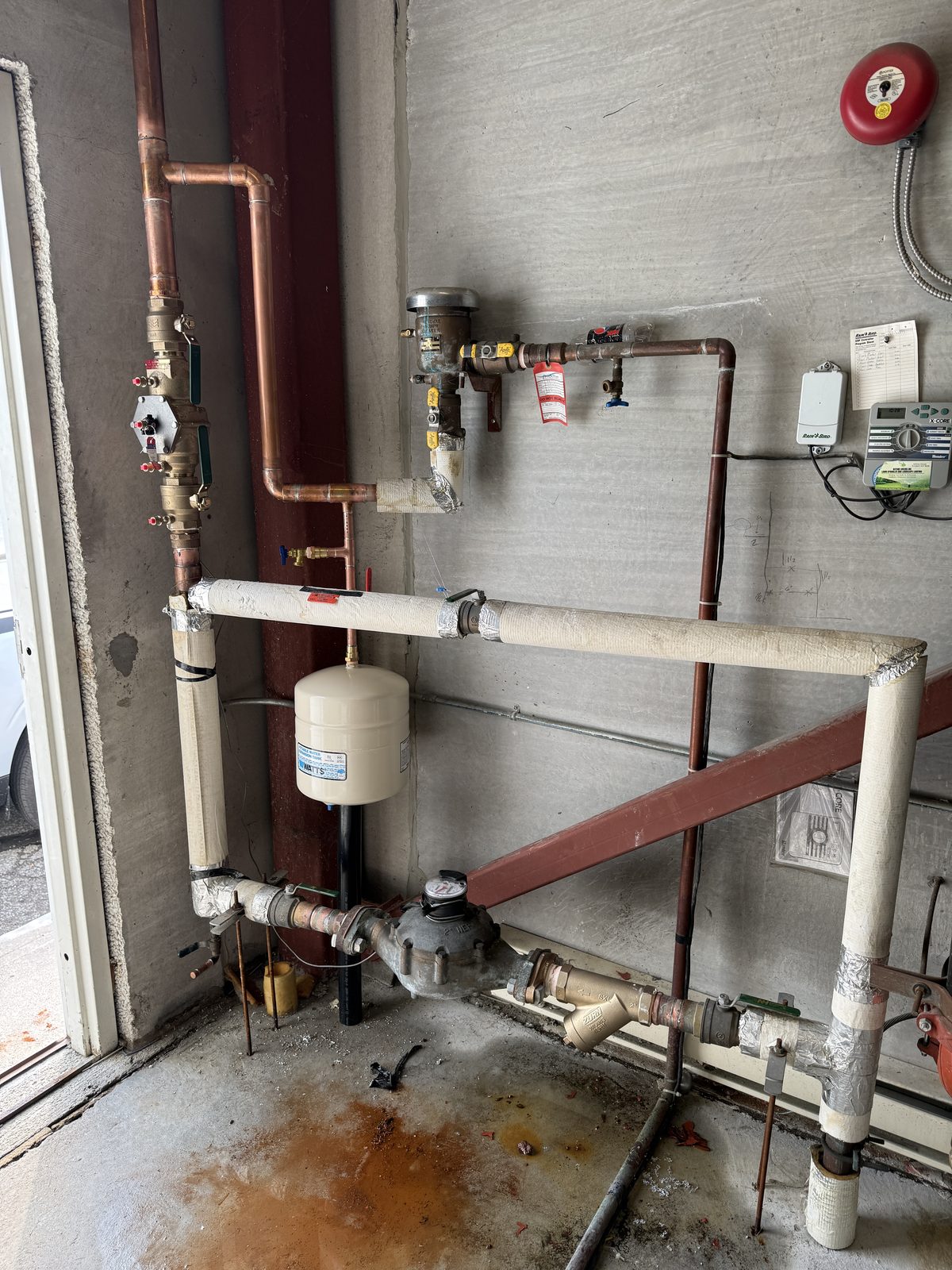
- a reduced-pressure assembly (RP, also called an RPZ) for a high or severe hazard;
- a double check valve assembly for a non-health hazard such as a fire sprinkler system (the by-law allows either device on a fire service);
- a double check detector assembly where the City's program page calls for one, on a moderate-hazard fire service.
The contractor installs the device on the water service downstream of the meter, under a building permit, and performs the initial test.
Every device is tested at installation, every year, whenever the City asks, and after any replacement, relocation or repair. The tester delivers the report and the City's fee within 14 days of the test. The tester also files a calibration certificate for the test kit with the City every year.
A permit for a new device in Hamilton
The City requires a building permit for every backflow preventer installation. The Building Division at City Hall, 71 Main Street West (905-546-2720), issues it. The owner or an agent applies through the City of Hamilton Customer Portal at my.hamilton.ca and pays the fee at application. The application gives the licence number of the contractor doing the work. The fee schedule lists $291 for the first premise or zone backflow preventer and $187 for each additional one (Schedule A to Building By-law 15-058, as amended in January 2025). No 2026 schedule had been published when this page was checked, so the amount is confirmed at application. After the initial test, the Building Division is called to schedule the device inspection, which the City's fee table lists at $190.69 in regular hours.
Who can test
Only persons with the qualifications in Schedule A, the by-law's Authorized Functions List, may survey, install, relocate, replace, repair or test a device. Each qualification covers only the functions listed for it. Registration with the City is annual. The master plumber or professional engineer registers the company's testers in person at 330 Wentworth Street North, with the test-kit calibration certificate. For a fire-protection company the master sprinkler installer registers. The City issues one registration number for all of them. A company whose licences are not kept up to date is classed as inactive and cannot submit documents under its number. The City publishes an Approved List of Contractors.
Working with us in Hamilton
Hamilton accepts surveys, installations, repairs and tests only from contractors registered with its Backflow Prevention Program. Send us the notice and we confirm the next step. Our certificates are listed on the Qualifications page.
Questions about backflow in Hamilton
Is a backflow preventer required for my property in Hamilton?
Under the by-law, every industrial, commercial, institutional and larger multi-residential property needs a premise-isolation device. The exception is a water service of 38 mm or smaller with a Self-Assessed Survey showing no high or severe hazard, where the Building Code does not require premise isolation. The hazard decides which device. A high or severe hazard needs a reduced-pressure assembly (RP); a non-health hazard such as a fire sprinkler system takes a double check valve assembly.
How often is it tested in Hamilton, and when is it replaced?
Every device is tested at installation, every year, whenever the City asks, and after any replacement, relocation or repair, with the report and the City's fee delivered within 14 days. There is no set replacement age; a malfunctioning device is repaired or replaced immediately.
What does backflow compliance cost in Hamilton?
The City charges $227.32 per Cross Connection Survey form and $75.25 per test report, HST included. The Self-Assessed Survey for a small water service is free. The building permit is $291 for the first device and $187 for each additional one. The device inspection is $190.69 in regular hours. Send us the notice and we confirm the next step.
Is a backwater valve the same as a backflow preventer?
No. A backwater valve is a sewer device that helps protect a basement from sewage backup. A backflow preventer protects the drinking water supply, and it is what the City of Hamilton's notice is about.
Who sends the notice in Hamilton, and who issues the permit?
The City's Backflow Prevention Program at 330 Wentworth Street North mails the survey and test acknowledgements. Orders under the by-law come from the City's by-law enforcement officers. Reports go to the program by mail, email or hand delivery, not through a portal. The building permit comes from the City's Building Division, which also inspects the installed device.
Sources
- City of Hamilton, Backflow Prevention Program — scope, survey types and service sizes, device types, building permit, testing frequency, submission routes, fees, contractor registration; Approved List of Contractors as of October 9, 2026, checked October 16, 2026
- City of Hamilton, Prevention of Backflow By-law 10-103 (office consolidation, September 20, 2021, PDF)
- City of Hamilton, By-law 19-057 amending By-law 10-103 (PDF)
- City of Hamilton, Building Permit Fees (page dated March 3, 2025)
- City of Hamilton, Building Permit Application Requirements (October 8, 2026)