
Guide
Backflow device types: RP, DCVA, PVB and detector assemblies explained
In our experience, four types of backflow preventer come up most often in GTA programs. Reduced-pressure assemblies (RPZ) protect against severe hazards. Double check valve assemblies (DCVA) protect against moderate and minor hazards. Pressure vacuum breakers (PVB) protect against backsiphonage only, usually on irrigation. Detector assemblies (DCDA or RPDA) are the fire-line versions. The hazard class decides which one you need. Toronto's and Vaughan's by-laws list hazard levels by sector. Elsewhere the survey identifies the hazard; in Peel, Halton and Hamilton the Region or City then sets the device.
Why there is more than one kind
A backflow preventer's job is to make sure water only moves one way: from the municipal main into your building. How much protection it has to provide depends on what could come back the other way. A dental surgery facility, a food plant or a chemical process is a severe hazard; Toronto's Schedule 5 lists a non-surgical dental office as moderate. The hazard class sets the device; who sets the class depends on the program (see Who decides, in the summary box).
The types
Reduced-pressure assembly (RPZ)
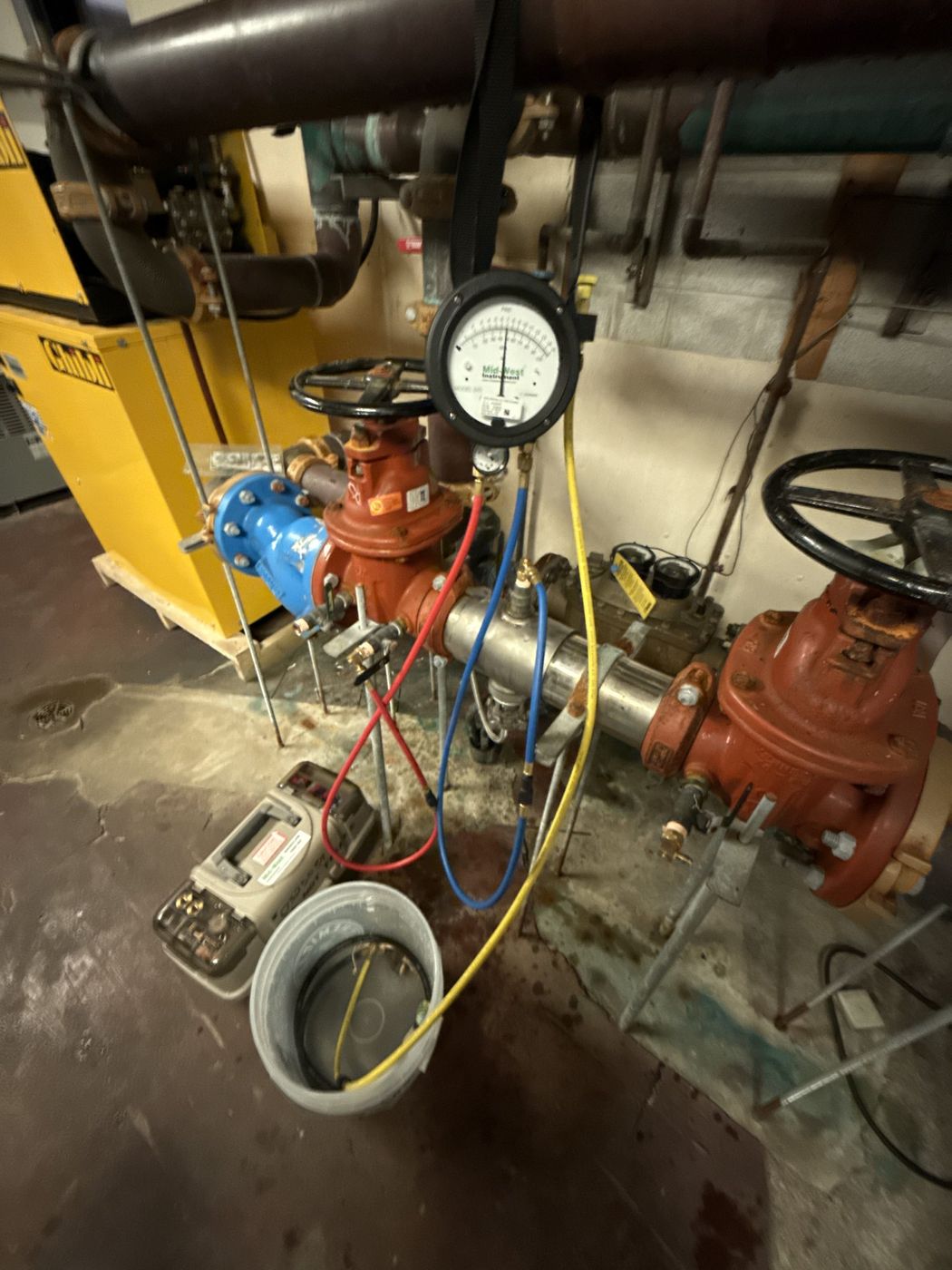
Two independent check valves with a relief valve between them that opens to atmosphere if either check leaks or if pressure conditions reverse. Programs also call it an RP. Because it is designed to fail safe by discharging, it is the device required for severe hazards. Examples are hospitals, medical and dental facilities, food processing, and industrial and chemical plants. It needs a drain for the relief discharge, so location matters.
Double check valve assembly (DCVA)
Two independent check valves in series, with test cocks but no relief valve. It protects against both backpressure and backsiphonage for moderate and minor hazards, which covers many offices, retail plazas and multi-residential buildings. It can be installed where an RPZ's discharge would be a problem. It cannot be substituted where the classification calls for an RPZ.
Detector assemblies (DCDA and RPDA)
The fire-sprinkler versions of the DCVA and RPZ. A small metered bypass runs in parallel with the main assembly, and any flow through it registers on the meter. They are tested in the same way, on the same annual cycle.
Pressure vacuum breaker (PVB) and spill-resistant vacuum breaker (SVB)
A single check with an air inlet that opens if the supply pressure drops. They protect against backsiphonage only, so they are used where backpressure cannot occur, typically irrigation systems. They must be installed above the highest downstream outlet. CSA also lists a spill-resistant version (SRPVB, often called an SVB).
Hose connection vacuum breakers
Small non-testable devices threaded onto hose taps. They protect a hose tap against backsiphonage, for example from a hose left in a sink or a bucket of water. They are not part of the annual testing program.
Premise isolation versus individual protection
Most municipal notices are about premise isolation: one assembly on the incoming service, right after the meter, that isolates the whole property. A survey may also identify specific equipment (a boiler feed, a chemical dispenser, a process line) that needs its own individual protection closer to the hazard. Both can be required on the same property.
What we install and service
We install and service backflow preventers from Zurn Wilkins, Watts and Apollo. Sizes run from ¾-inch domestic services up to large industrial and fire-line assemblies. The 4-inch RPZ in our field notes protects a food-processing plant. Every installation includes the building permit and the first test, filed with your municipality.
Questions
What is the difference between backpressure and backsiphonage?
Backpressure is when pressure inside the building rises above the supply pressure (a pump, a boiler, elevated piping) and pushes water backward. Backsiphonage is when the supply pressure drops (a main break, hydrant use nearby) and draws water backward. RPZ and DCVA assemblies protect against both. A PVB protects only against backsiphonage.
Why does an RPZ need a drain?
Its relief valve discharges water when the checks fail or the pressure conditions call for it. That discharge needs a floor drain or a drain line sized for it, so the location is planned before the permit is applied for.
Can a DCVA be used where an RPZ is required?
No. The device type follows the hazard classification. If the municipality classifies the sector as severe, an RPZ is required. A survey establishes the hazard for the property.
Which devices get tested every year?
Every testable assembly: RPZ, DCVA, PVB, SVB and the detector assemblies. Hose connection vacuum breakers are not testable devices.
Sources
- City of Toronto, Backflow Prevention Program (device types and Schedule 5 hazard levels)
- Region of Durham, Backflow Prevention Program (RP for severe, DCVA for moderate)
- Halton Region, Cross-Connection Control Program (severe hazard examples)
- CSA Group, CSA B64 Series (the device standards and their names)