
Guide
What happens during a backflow test, and how often it is required
A backflow test is a short site visit by a certified tester. The tester connects a calibrated test kit to each assembly and checks that both check valves hold and that the relief valve opens at the right point. The tester then records the readings, tags the device and files the report with your municipality. The programs on this site require the test at least once a year, and most also require it at installation and after a repair.
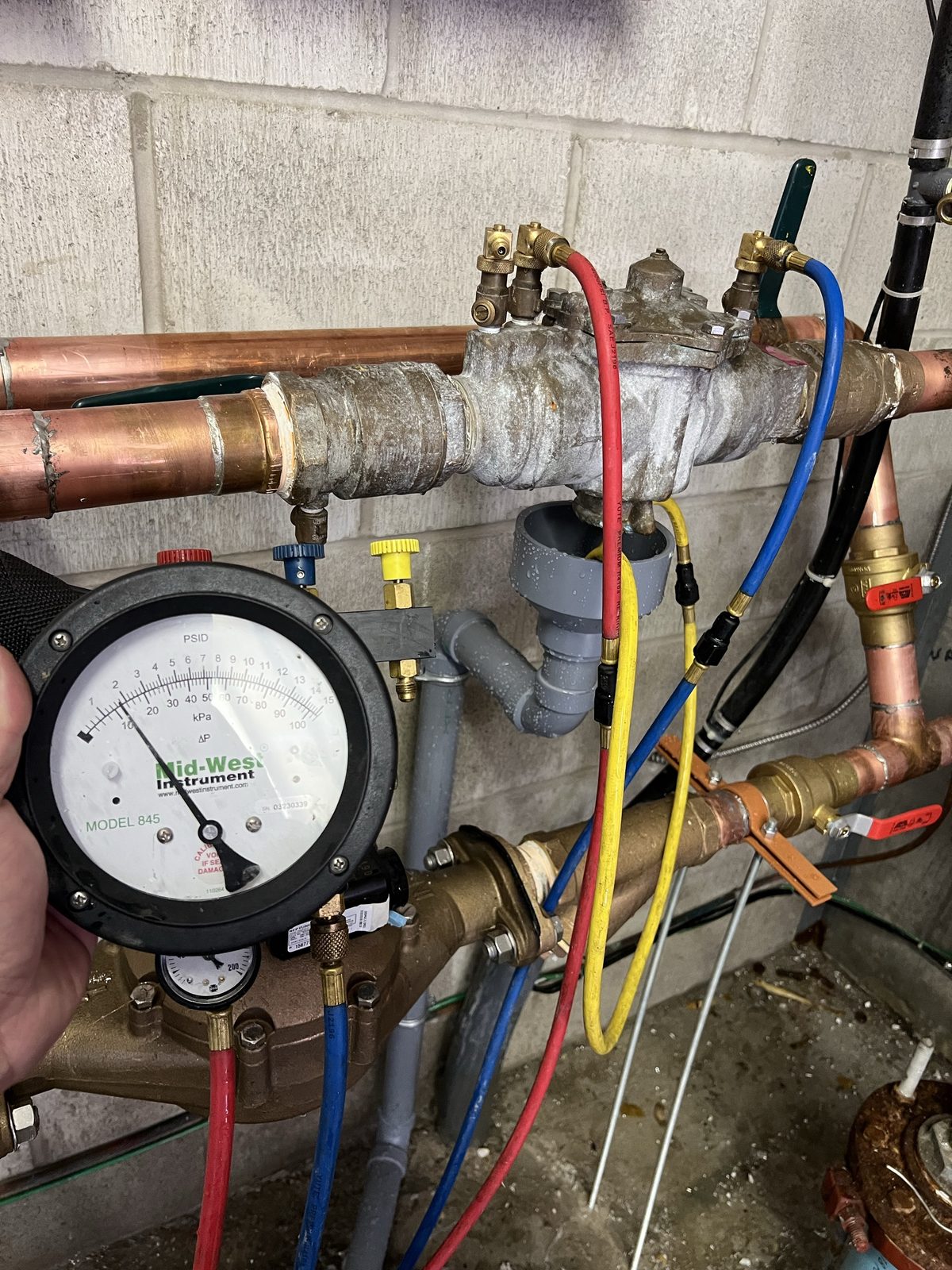
Before the visit
You receive a confirmed date and time window. We ask for three things in advance:
- where the devices are (mechanical room, meter room, irrigation vault, fire-line room);
- who will let us in;
- whether a brief water shutdown needs to be timed around a tenant, a kitchen or a process.
If you have a notice or last year's report, send it. The device's size, type and serial number let us bring the right kit and the right parts.
The test itself
- Identify the assembly. The tester records the make, model, size, serial number and location, and checks the tag from the last test.
- Close the outlet. The shut-off valve after the assembly is closed, which stops the water through it for the length of the test. Where a building has a second assembly in parallel, we test one at a time so the supply stays on.
- Connect the test kit. Hoses from a calibrated test kit are attached to the assembly's test cocks, the small ports on its body.
- Run the checks. The exact procedure depends on the device type:
- Double check valve assembly (DCVA): each check valve is tested to confirm it holds the required differential pressure in the closed direction.
- Reduced-pressure assembly (RPZ): both checks are tested, and the relief valve is checked to confirm it opens at the required point. The programs require an RPZ, not a DCVA, where the hazard is severe.
- Pressure vacuum breaker (PVB): the air inlet and the check valve are tested.
- Record the readings. Pass or fail is set by the limits in CSA B64.10.1.
- Restore service, tag the device and file. The outlet valve is reopened, and a tag with the date and result goes on the device. The report is submitted to the municipality, for example through Toronto's online form or through Backflow Solutions Inc. (BSI) for Durham. You receive a copy and the filing confirmation.
If the device fails
In our experience a failed test usually means a repair, not a new assembly. The most common cause we see is debris caught between a check valve disc and its seat, which stops the check from sealing. The field note on fouled RPZ checks shows an example. Other causes are worn rubber, a relief valve that does not open, or shut-off valves that do not hold.
You receive a written repair scope. If you approve it, the repair is done, often with a rebuild kit rather than a new device. The assembly is then retested, and the new report is filed.
Toronto: repair within 48 hours of a failed test and retest within 72 hours of the repair. Halton: repair or replace within 96 hours. Durham: report a failure within 24 hours.
How often
The programs on this site require the test, with the exceptions noted:
- when the device is installed (Durham's by-law states only the annual test),
- after it is cleaned, repaired, replaced or serviced, in most programs (Halton sets no retest after a repair; Durham asks for one with a repair notice), and
- at least once a year after that.
What you should keep
Keep the test report, the filing confirmation and any repair invoice. Municipal auditors ask for them, and in our experience insurers and purchasers do too. The report is the fastest way to answer "when was it last tested" without a site visit.
Toronto requires copies of the records submitted to the City to be kept on the property for 7 years. Peel and Durham require test reports to be kept on site for 5 years.
Questions
How often does a backflow device have to be tested in the GTA?
Every program on this site requires a test at least once a year. Most also require one when the device is first installed and after a repair, cleaning or replacement. Halton's and Durham's by-laws name no retest after a repair. Both regions can require one, and a Durham notice to repair requires the device to be repaired and tested. Toronto requires the retest within 72 hours of the repair.
Can I test the device myself?
No. Programs accept reports only from certified Cross-Connection Control Specialists who are registered with the municipality. Each program sets its own tester requirements; your municipality's page lists them. The tester uses a calibrated test kit.
Do you need to shut the water off?
Only to the assembly being tested, and only while the test runs. For a premise-isolation device we close its outlet valve, so the building's supply is off for the length of the test unless a second assembly carries it. We schedule the visit around your tenants' needs.
What does the tag mean?
The tag records the test history on the device itself. Toronto requires one on every device. Richmond Hill issues a digital tag once the fee is paid. In our experience an inspector looks first for a tag with a recent date and a pass result.